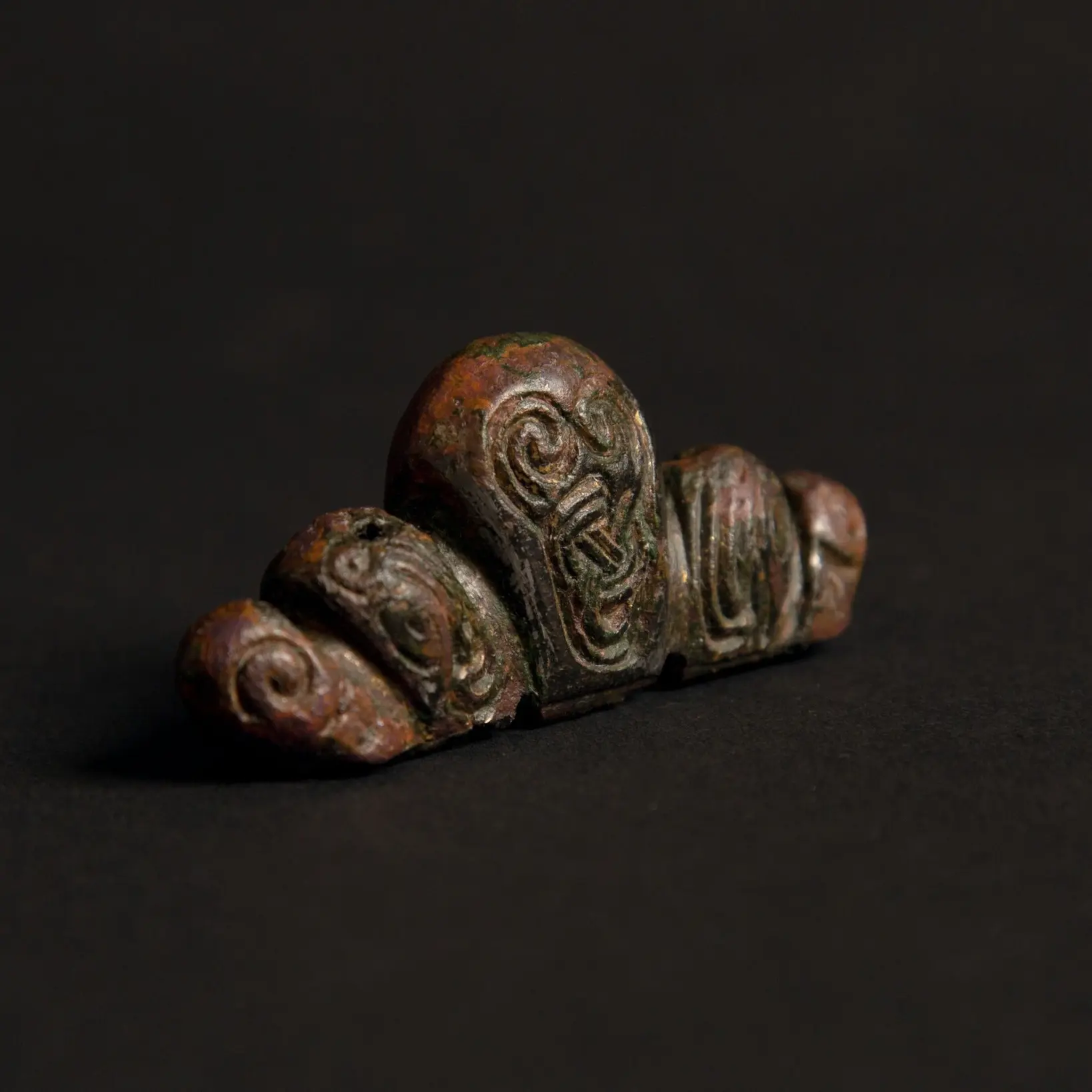
For centuries, the story of the Frisians during the Viking Age has been told as one of defense: of coastal watches, burning churches, and the struggle to maintain the Frisian Freedom against Norse raiders. However, the 2024 discovery of a stunning 10th century Viking sword pommel cap near the village of Witmarsum has forced historians to look closer at the gilded side of this relationship.
The artifact is the first of its kind found in the Netherlands. Its presence suggests that Frisia was not just a victim of the Viking world but a high status participant in its most elite cultural networks.
The Clear Sound of History: The Discovery
In May 2024, metal detectorist Sander Visser was scanning farmland in the northern Netherlands when his device emitted a high, clear sound. Buried just twenty centimeters beneath the sod was a fragment of history: a copper alloy pommel cap, still bearing traces of the gold that once made it shimmer.
An "Epic Sword"
This was not just any scrap of metal. It was the crowning piece of what Dr. Diana Spiekhout of the Fries Museum describes as an Epic Sword. Such weapons were much more than tools for war. They were treated as living beings with human characteristics, acting as symbolic anchors for the elite families who owned them.
Artistry of the Mammen Style
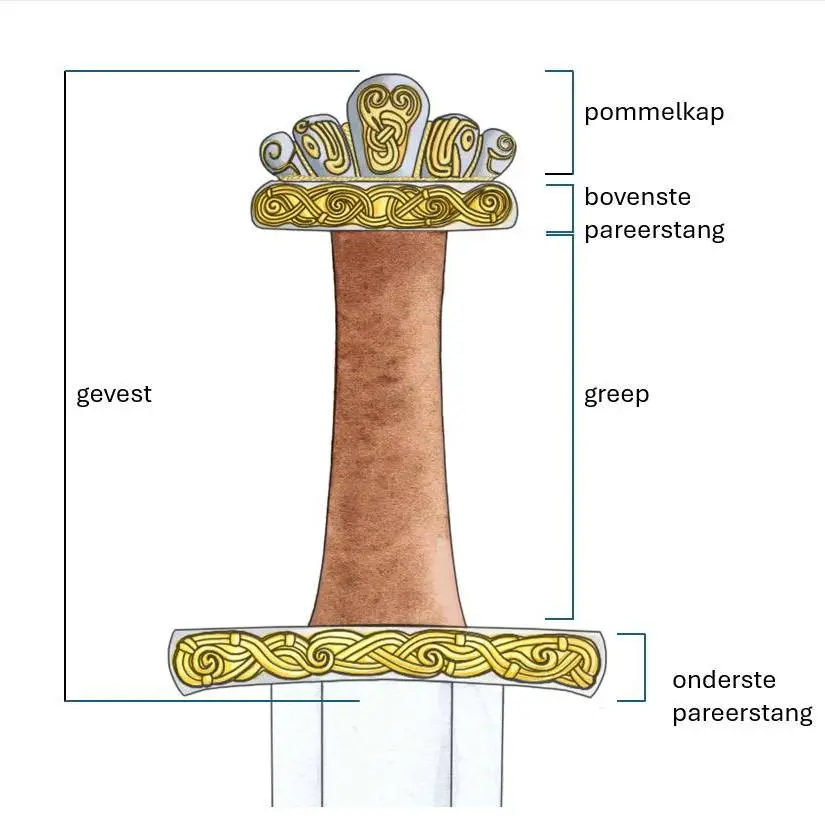
Sword Hilt Components
- pommelkap = pommel cap
- bovenste pareerstang = upper guard
- gevest = hilt
- greep = grip
- onderste pareerstang = crossguard
The Witmarsum fragment is decorated in the Mammen style, a prestigious Viking art style that flourished between about 950 and 1000 CE. The style is named after a famous silver-inlaid axe from a high-status grave at Mammen, Denmark; the person buried there has not been identified as royalty.
The reconstruction shown here illustrates how the pommel cap would have sat atop the original sword. The gilded ornamentation would have matched the upper guard and crossguard, forming a visual unity that proclaimed the owner's status.
The Wild Boar Heads
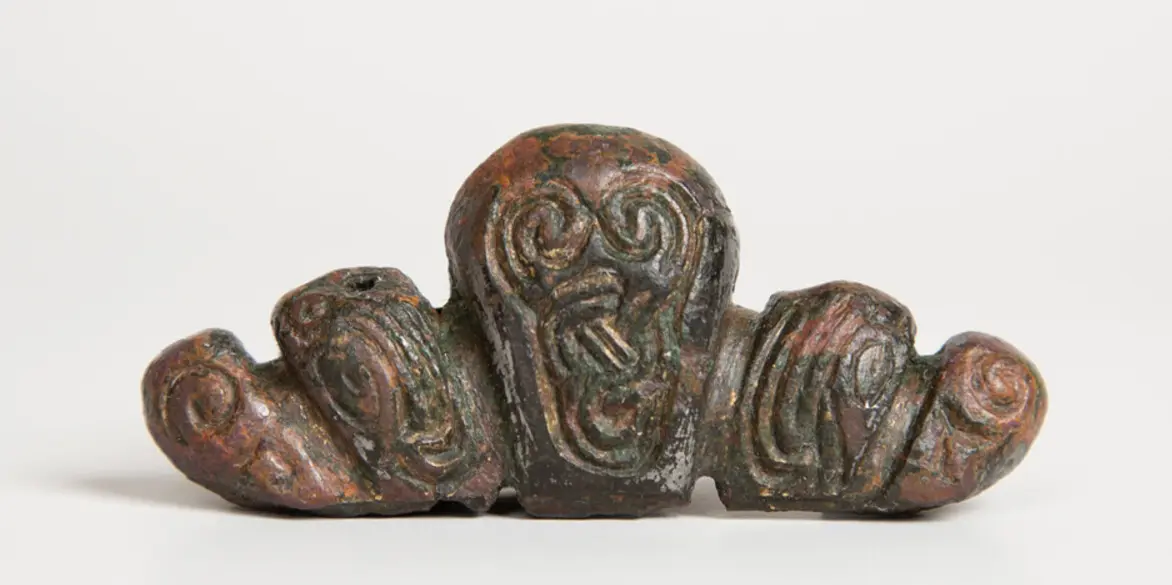
Front view showing the central foliate patterns
Most striking are the wild boar heads on either end of the cap. Their snouts curl upward in a snarl of defiance that remains clearly visible today. In the shared Germanic world of the Anglo Saxons and Frisians, the boar was a potent symbol of:
- Strength and Protection: Much like the boar crested helmets described in the Old English epic Beowulf, the animal was believed to guard the wearer in battle.
- Divine Connection: In Norse mythology, the goddess Freya rode the battle swine Hildisvíni.
The presence of such high tier Scandinavian art in Frisian soil highlights a cosmopolitan 10th century world where Anglo Saxon, Frankish, and Norse cultures blended together.
Open Questions: A "Scalped" Blade?
How the pommel cap ended up alone in a field remains unresolved. The Fries Museum and Fryske Akademy presented it in 2024 as an open research question: was only the cap removed, or was the whole sword taken apart?
"Scalped" Swords
The museum's 2024 announcement raised two possibilities without choosing between them:
- Customization: A later owner may have removed the ornate cap while altering or re-hilting the weapon.
- Disassembly: The whole sword may have been taken apart because of damage, reuse, or an action whose meaning can no longer be reconstructed.
Early medieval swords were sometimes modified and passed between generations. The Witmarsum find fits that wider practice, but without the missing sword it cannot prove any one scenario.
Frisia in the Viking Network
Dr. Nelleke IJssennagger-van der Pluijm, director of the Fryske Akademy, emphasizes that this find enriches our understanding of the contacts between Frisia, Scandinavia, and the British Isles. The Mare Fresicum (the Frisian Sea) was the central highway of the early medieval world.
This gilded artifact was not necessarily dropped by a raider. It could just as easily have belonged to a Frisian merchant noble who moved comfortably between the courts of York and Hedeby. It serves as a reminder that the "Viking Age" was a shared North Sea phenomenon, shaped by Frisian sailors and Anglo Saxon smiths as much as by Norse warriors.
Where to See the Find
The Witmarsum pommel cap belongs to the Fries Museum collection in Leeuwarden. Another celebrated object in that collection is the massive 15th-century two-handed sword traditionally associated with Grutte Pier.
Sources and Further Reading
- Fries Museum: Official report on the "Viking Sword Fragment discovered in Frisian Soil" (2024/2025)
- Fryske Akademy: Research notes on Viking-Frisian relations and the Mammen Style
- Heritage Daily: "First of its kind Viking discovery in the Netherlands" (November 2024)
- The History Blog: Detailed analysis of the Witmarsum pommel and Mammen dendrochronology
- National Museum of Antiquities (RMO): Above Ground Level exhibition catalogue (2025)