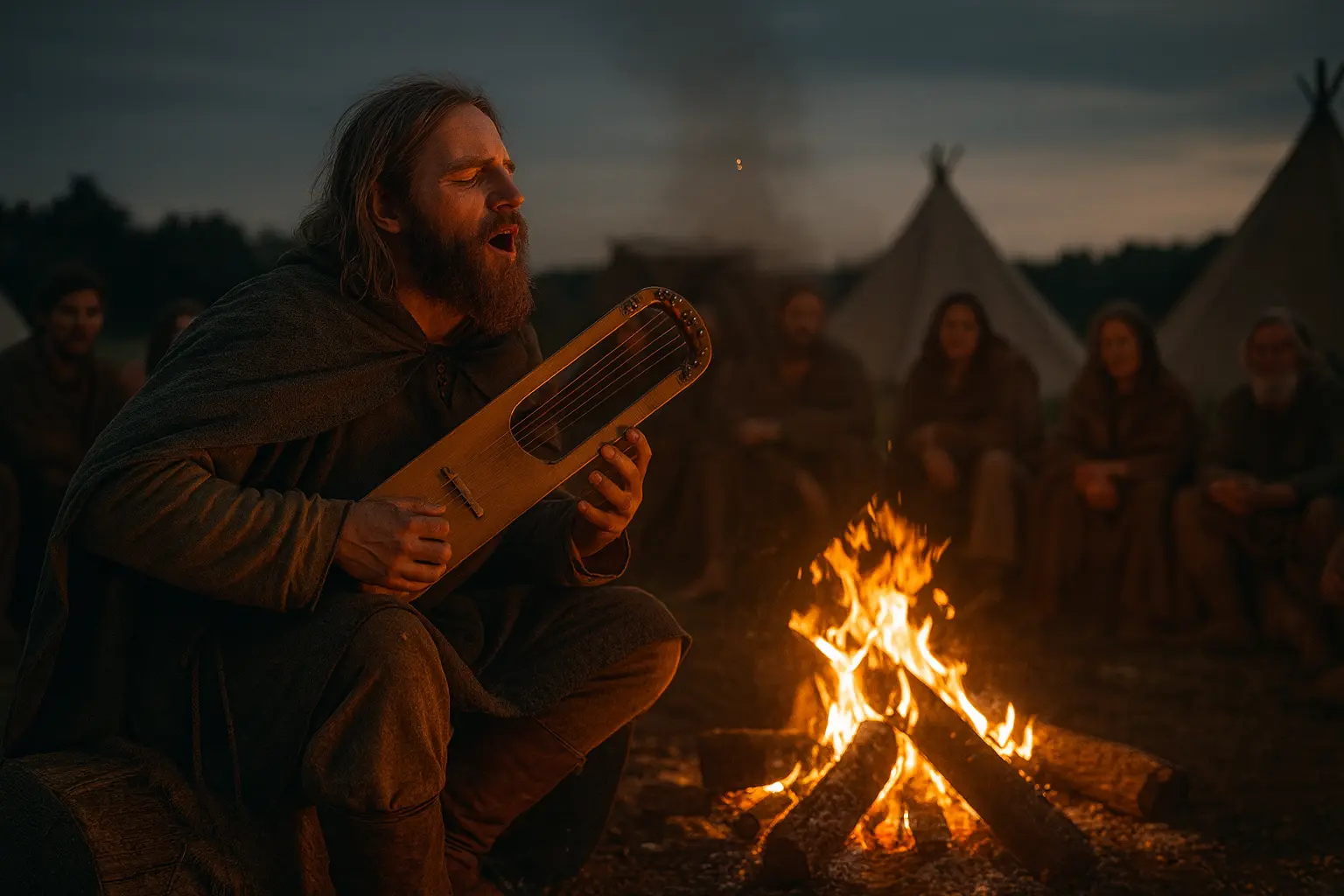
Anglo Saxon music and early medieval Frisian musical traditions emerge from fragments: buried lyres, surviving poems, and echoes of ancient chants. Though centuries have silenced these voices, archaeological evidence and scholarly reconstruction offer glimpses into a shared soundscape that once unified the North Sea Germanic world.
Archaeological Evidence: Medieval Lyres and Instruments
The Lyre: Symbol of Status and Song
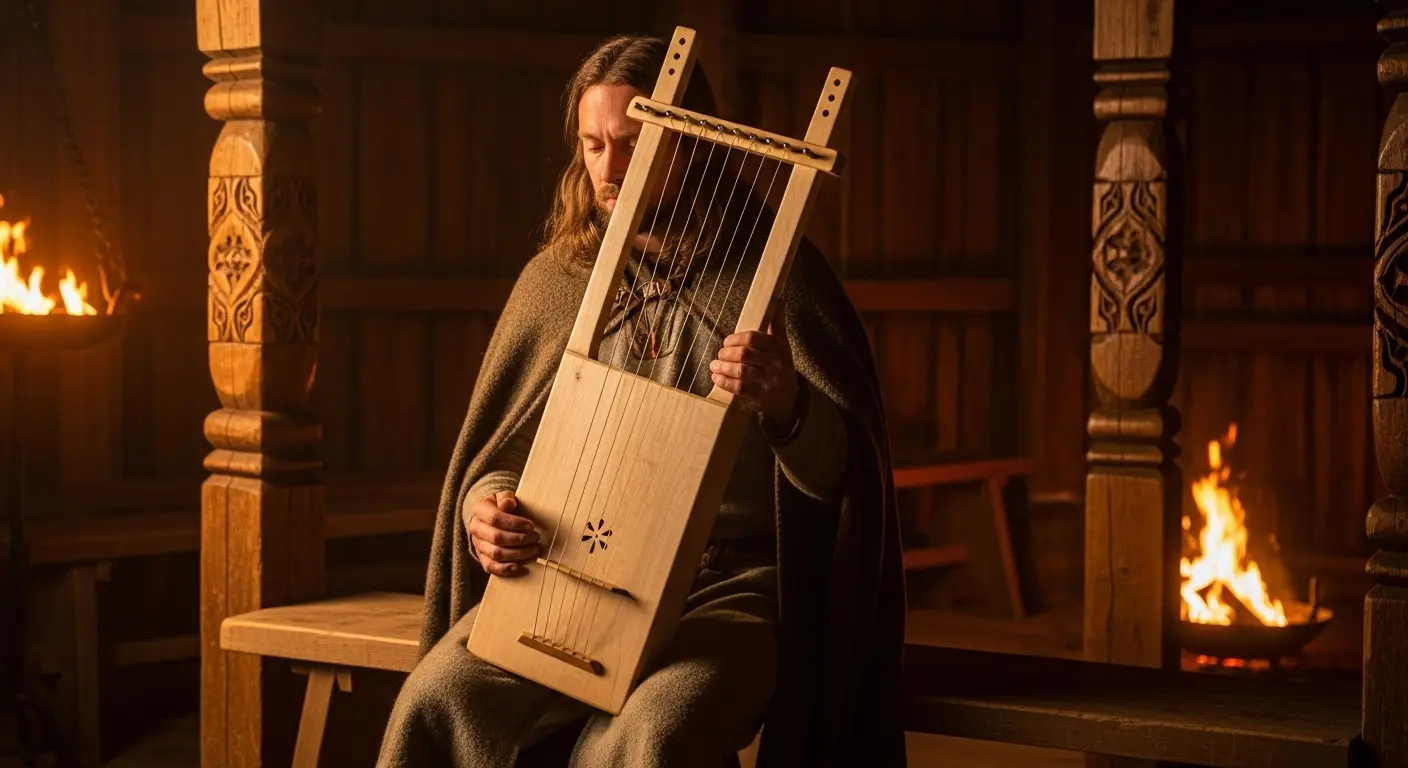
The strongest evidence for Anglo-Saxon music comes from elite burials. Sutton Hoo contained a six-stringed maple lyre; comparable lyres were found at Taplow and Prittlewell, but the string count is not established for every instrument. Lyres of this family generally had five to seven strings and show the importance of music in elite culture.
Frisian Archaeological Evidence: Terps and Treasures
No confirmed musical instruments have been published from Wijnaldum or Ezinge. Their finds do document elite contacts, craft, and daily life. Close links with Anglo-Saxon communities make comparable musical traditions plausible, but that remains an inference by analogy rather than direct archaeological evidence.
Bone and antler objects from terp excavations should not be labelled as whistles or flutes without diagnostic features such as a sound edge and deliberately bored finger holes. Confirmed bone pipes are known from other early medieval sites, but they cannot simply be attributed to Ezinge.
The archaeological record demonstrates active cultural exchange along North Sea trade routes, creating opportunities for musical innovation and the circulation of both instruments and performance traditions between Frisian, Anglo-Saxon, and continental communities.
Instrument Construction and Tuning Systems
Analysis of the Sutton Hoo lyre reveals detailed construction methods. These instruments were crafted from maple wood with animal gut strings. The Sutton Hoo example measures 73 cm in length with a corpus depth of 9 cm, designed to accompany human voice without overwhelming it.
Reconstructing original tuning systems remains highly speculative. Some scholars propose modal scales based on comparative Germanic folk traditions, though concrete evidence is limited. Experimental reproductions suggest these instruments may have used pentatonic systems that allowed basic harmonic intervals while accommodating medieval modal practices.

Confirmed early medieval bone pipes from sites outside Ezinge show varied construction, from simple whistles to instruments with several finger holes. Replicas can explore their possible range and timbre, but cannot by themselves establish the melodies, scales, or ecclesiastical roles of the originals.
Sounds of Daily Life
Beyond the elite sphere, simpler instruments tell stories of everyday music. Bone whistles, typically featuring two or three finger holes, appear frequently in both Anglo-Saxon and Frisian archaeological contexts. These humble instruments accompanied shepherds in pastures, children at play, and workers in fields.
Wooden panpipes discovered at trading centers like York hint at musical exchange between cultures, while the livestock bells found in Frisian farmsteads created a distinctive rural soundscape that marked the rhythms of agricultural life.
Anglo-Saxon Scop Poetry and Frisian Musical Traditions
Literature associates poetry, song, and the lyre within the Anglo-Saxon hall. The scop is therefore often reconstructed as a poet-musician with a lyre, though scholars debate whether the instrument accompanied verse continuously or provided interludes. Such poets helped preserve genealogy, heroic narratives, and cultural memory.
"Then was song and music mingled together
before Healfdene's battle-leader;
the harp was struck, tales oft recounted..."
Bede's Ecclesiastical History says that Cædmon left a feast when he saw the lyre approaching him because he could not sing. This is often paraphrased as the instrument being passed among the guests, but that modern wording is not a direct quotation from Bede (Book IV, chapter 24).
Frisian Legal Songs and Ritual Formulas
The Lex Frisionum was compiled in Latin around 802 and does not contain the quoted Old Frisian phrases. Later Old Frisian law texts, including the Asegabók and the Seventeen Statutes, do use formulaic and alliterative language that may reflect oral composition. That is different from evidence that the laws were sung.
Particularly suggestive are ritual proclamations preserved in the Codex Unia (completed 1475, but preserving earlier legal traditions) and related manuscripts. Frisian oaths like "Deer is een vrye ende vrij libbet" (where one is free and lives free) and "So feer so de Fresena frethe reicht" (as far as Frisian peace reaches) are marked by intricate rhyme schemes and rhythmic patterns that suggest they were sung rather than spoken.
The Asegabók (law-book), with manuscripts dating to around 1300 CE, preserves the oral traditions of Frisian lawspeakers (asegas) who presided over thing-gatherings. Scholars studying Old Frisian legal texts have identified strong traces of orality, including rhythmic structures and mnemonic devices designed for public proclamation. This suggests Frisian legal tradition shared common roots with Anglo-Saxon practices in a broader Germanic tradition of performed law.
Sacred and Secular: The Christian Transformation
The arrival of Christianity (6th-8th centuries) brought sweeping transformation to Anglo-Frisian musical practices. Augustine's mission to Canterbury in 597 CE marked the beginning of systematic Latin liturgical tradition in England, while Boniface (c. 675-754) and other Anglo-Saxon missionaries brought comparable changes to Frisian territories. This wasn't a violent replacement of old traditions, but a complex weaving together where Christian and pagan forms intermingled.
The Winchester Troper: Revealing Anglo-Saxon Christian Music
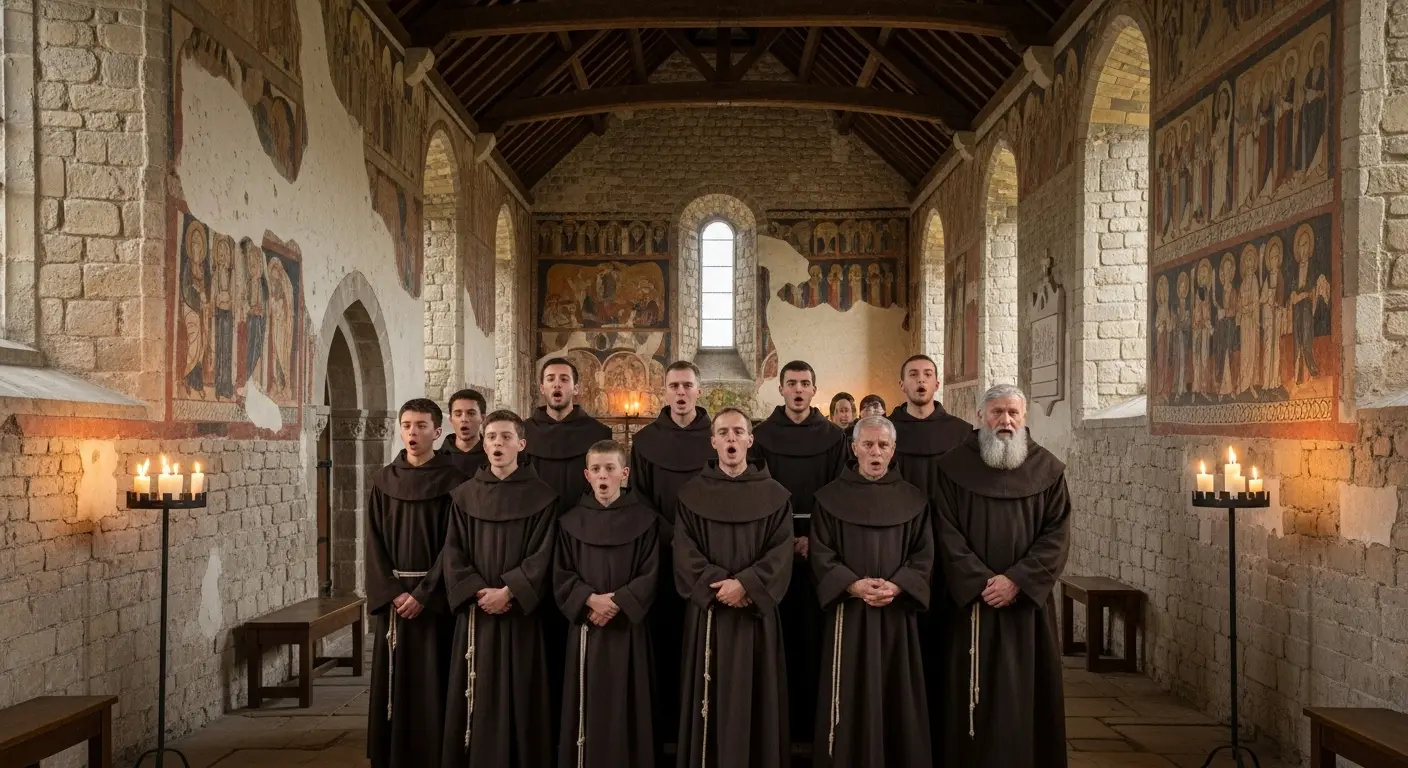
The Winchester Troper (CCCC 473 and Bodley 775), copied at the Old Minster in Winchester in the 1020s–1030s, is especially important as the earliest substantial collection of Western polyphony: two-voice organum. The manuscripts also preserve Gregorian chants and tropes in neumatic notation, which indicates melodic movement without fixing every detail of pitch and rhythm.
Particularly significant is that the manuscript reveals Anglo-Saxon musicians weren't passive adopters of Roman traditions. They created new compositions, adapted existing chants, and developed distinctive liturgical styles that reflected their own interpretation of Christian mysticism. Texts like "Kyrie rex splendens" show how Latin phrases were infused with local musical sensibilities.
The transformation wasn't limited to monasteries. In local parishes, Christian holidays, Christmas, Easter, Pentecost, began developing their own musical traditions, often incorporating elements borrowed from older seasonal rituals. Choral singing introduced by itinerant monk-preachers mixed with local folk melodies, creating hybrid forms that bridged both worlds.
Instrumental adaptations showed the same creative tension. Traditional lyres, once used for heroic poetry, began accompanying Christian hymns. Bone whistles, probably first used for shepherd songs and work tunes, found new roles in liturgical contexts. Even bells, a new technology imported from continental monasteries, created acoustic landscapes that marked Christian temporality across Anglo-Frisian territories.
Yet vernacular traditions persisted in vital capacities. Cædmon's Hymn (c. 658-680), composed in Old English but addressing Christian themes, represents this synthesis perfectly. Recorded by Bede, this tells the story of a cowherd who received a vision to compose Christian songs using traditional Anglo-Saxon alliterative meter. This wasn't just poetry but active cultural transformation: old forms carrying new content, proving that Christianity and indigenous tradition weren't antagonistic but creative partners.
Regional Variations and Social Contexts
Seasonal and Ceremonial Music
Beyond courtly and religious contexts, Anglo-Frisian communities likely developed seasonal and ceremonial music tied to agricultural cycles. While specific harvest songs and seasonal chants from this period are not preserved, the broader cultural evidence suggests work songs and ritual music accompanied major agricultural and seasonal activities. Major assembly sites like Lejre (Denmark) and Yeavering (Northumberland) feature specialized feasting halls and staging areas for royal gatherings. While specific musical evidence is limited, the cultural context strongly suggests music accompanied these ceremonial events.
Frisian terp-communities developed specific traditions related to sea and land life. While Frisian maritime culture was extensive and terp-construction required coordinated communal labor, no specific medieval evidence survives for "sea-shanties" or "terp-songs" from this period. Such work songs would likely have existed given the practical needs, but documented sea shanties emerge in the historical record only from the 19th century onward.
Trade and Cultural Exchange
Musical innovation followed trade routes. York, Lundenwic, and Dorestad created cultural nodes where Anglo-Saxon, Frisian, Frankish, and Scandinavian musical traditions mingled. Archaeological evidence of exotic instruments, like panpipes of continental origin found in Anglo-Saxon contexts, or Scandinavian-style bells discovered at Frisian sites, shows that musical culture actively exchanged between cultures.
The circulation of musicians between royal courts is suggested by the itinerant nature of gleemen (traveling musicians) who by definition moved from court to court seeking patronage. While specific documented exchanges are rare, the political integration of Anglo-Saxon kingdoms and cultural connections across the North Sea trading networks would have facilitated the spread of instrumental techniques, musical styles, and repertoires.
Modern Reconstruction of Medieval Music
Reconstruction Methodology: Challenges and Limits
Reconstructing early medieval music faces fundamental challenges. While archaeologists recover instruments and manuscripts preserve notation, the actual sounds, playing techniques, and performance traditions remain largely lost. Modern scholars must combine fragmentary evidence from diverse sources to approximate these musical practices.
Key challenges include determining tuning systems, acoustic properties, and interpretive practices. Scholars use comparative ethnomusicology from related cultures to fill these gaps.
Far more complex is the problem of "authenticity." Often reconstructionists must choose between comparative archaeological accuracy (with all its unknowns) and musical viability (that audiences can actually experience). Peter Pringle opts for accuracy, limiting his palette to what can be archaeologically proven. Benjamin Bagby opens to more speculative approaches, using comparative linguistics to construct musical ornaments that don't appear directly in the archaeological record.
Scholarly Approaches
Contemporary musicians and scholars work to bridge the centuries-long silence through careful reconstruction of Anglo-Saxon and Frisian musical traditions. Their approaches vary from rigorous historical accuracy to atmospheric interpretation. The most successful projects combine archaeological evidence, comparative musicology, and artistic intuition.
Peter Pringle
Pringle's performance of Cædmon's Hymn on a reconstructed lyre has garnered over 500,000 views on YouTube. His austere, contemplative delivery captures the weight and sacred simplicity of early English verse.
Benjamin Bagby & Sequentia
Benjamin Bagby, co-founder of the medieval music ensemble Sequentia, has devoted decades to reconstructing the oral performance traditions of early medieval Europe. His groundbreaking work focuses on recreating the experience of the Anglo-Saxon scop (court poet), drawing from manuscript evidence, comparative linguistics, and ethnomusicological research from related Germanic traditions.
Bagby's solo performances of Beowulf represent rigorous attempts to resurrect Anglo-Saxon musical recitation. Using a replica harp based on archaeological finds, he employs reconstructed Old English pronunciation and follows traditional alliterative meter. His performances demonstrate how these texts may have sounded in early medieval mead-halls.
Sequentia's broader work encompasses the musical traditions of medieval monasteries, focusing on the earliest notated music from Frankish and Anglo-Saxon sources. Their research methodology combines archaeological evidence, manuscript study, and performance practice to create what may be our closest approximation to authentic early medieval sound.
Historical Accuracy vs. Atmospheric Interpretation
Modern revival efforts follow two approaches. Historical reconstructionists prioritize archaeological accuracy, creating performances that likely approximate authentic Anglo-Saxon sound. Their work features modal tunings, limited instruments, and traditional metrics.
Atmospheric groups like Wardruna and Heilung create immersive experiences evoking Germanic antiquity. Their layered, amplified music functions as ritual theater, connecting modern audiences with ancient mythic themes rather than strict historical reconstruction.
Baldrs Draumar and Sowulo
Baldrs Draumar is a genuine Frisian folk group performing in Modern Frisian, positioning themselves as modern skalds carrying forward regional traditions through acoustic storytelling and contemporary folk arrangements. Sowulo, based in Arnhem (Gelderland), works in a different tradition: their neo-pagan folk uses Old English (Anglo-Saxon) texts, bridging atmospheric revival with historical awareness.
Neither approach is superior; they serve different purposes. Reconstruction preserves fragile knowledge and offers windows into lost worlds. Atmospheric revival engages contemporary audiences with early medieval themes, demonstrating how historical research can inspire modern artistic expression.
A Listener's Guide to Anglo-Frisian Musical Heritage
Historical Reconstruction
- → Peter Pringle - Cædmon's Hymn
- → Sequentia - Beowulf prestaasjes
- → Sequentia - The Wanderer & oare elegyen
Atmospheric & Regional Folk
- → Sowulo - Old English (Anglo-Saxon) chants
- → Baldrs Draumar - Frisian folk narratives
- → Wardruna - Germanic atmospheric
The Continuing Song
The musical heritage of Anglo-Saxon England and early medieval Frisia survives in fragments that reveal rich traditions where song, story, and social memory intertwined. From elite lyres to humble bone whistles, from monastic chants to work songs, music shaped every level of early medieval life.
Today's reconstructions serve as bridges across the centuries, allowing us to hear echoes of early medieval voices. These efforts reveal not just entertainment, but evidence of social and cultural practices that shaped historical communities and influenced the development of northwestern European languages and literatures.
Related Articles
Primary Sources and Archaeological Evidence
- → Beowulf (c. 975-1025 CE manuscript) - Anglo-Saxon heroic poetry with musical references
- → Winchester Troper (1020s–1030s) - earliest substantial Western polyphony
- → Lex Frisionum (c. 802, Latin) and later Old Frisian legal texts
- → Bede's Ecclesiastical History (731 CE) - Cædmon's Hymn and musical traditions
- → Sutton Hoo lyre (c. 625 CE) - Archaeological find, British Museum
- → Wijnaldum and Ezinge Revisited - Frisian context, but no confirmed instruments
Modern Scholarly Works
- → Carver, Martin. Sutton Hoo: A Seventh-Century Princely Burial Ground (2005)
- → Page, Christopher. Voices and Instruments of the Middle Ages (1987)
- → Hines, John. The Anglo-Saxons from the Migration Period to the Eighth Century (1997)
- → Bazelmans, Jos. By Weapons Made Worthy: Lords, Retainers and Their Relationship in Beowulf (1999)
- → Bagby, Benjamin. "Beowulf, the Edda, and the Performance of Medieval Epic" Traditional Drama Studies (2000)
- → McKinnon, James. The Advent Project: The Later-Seventh-Century Creation of the Roman Mass (2000)
- → Nieuwhof, Annet. Ezinge Revisited: The Ancient Roots of a Terp Settlement (2020)